

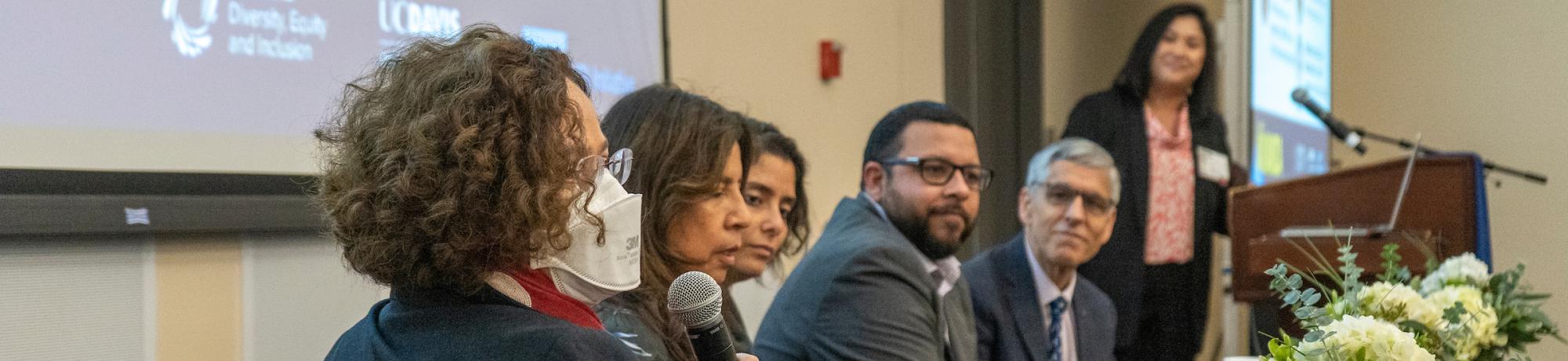

The Blueprint program is aimed at helping academic departments assess their climate with specific attention to diversity, equity, inclusion, and belonging. Formerly a pilot program funded by the University of California, Office of the President, the Blueprint Program has become an established program. The initial grant proposal, AFD Climate and Retention Pilot Intervention Program UC Davis, UC San Francisco, UC Berkeley, outlined the need and implementation of an easy-to-use blueprint to address campus climate across departments regarding diversity, equity, and inclusion across the three universities.
The goal of Blueprint is to make departments more inclusive for all, increasing faculty retention and success. Using a quasi-experimental design, Blueprint has two components: (1) an online climate survey Question Bank, containing validated survey items participating departments can choose from to create customizable climate surveys appropriate to their unique context; and (2) a Climate Toolkit to support responsive activities. Toolkit elements will be associated with particular issues and span a wide range of accessible activities. _____________________________________________________________________
Our Blueprint Ambassadors
Blueprint Ambassadors represent those departments that have utilized the Blueprint program and found it helpful in considering ways to support and improve their department climate. Blueprint Ambassadors are willing to talk about their experiences with the Program. Feel fee to contact them if interested.
Satyhan Lakshminrusimha, MD
Distinguished Professor and Dennis and Nancy Marks Chair of Pediatrics, Pediatrician-in-Chief, UC Davis Children's Hospital, Executive Associate Dean, UC Davis School of Medicine.

"Participating in the UC Blueprint project provided us with invaluable, data-driven insights into our organizational climate. By leveraging these comprehensive survey results, we were able to reshape our pediatric department's strategy and implement targeted, corrective interventions. Ultimately, this initiative empowered us to significantly enhance both physician and staff engagement, serving as a catalyst for a stronger, more connected workplace."
Dr. Lakshminrusimha serves as an ambassador of the Blueprint Program at UC Davis and welcomes the opportunity to discuss his experiences. He can be reached at [email protected]
___________________________________________________________________
David A. Gold, PhD
Professor of Earth and Planetary Sciences, Curator of the UC Davis Fossil Collection

"UC Blueprint helped our academic department navigate a turbulent period. The climate survey they helped us design gave us a clearer understanding of which groups were struggling and where support was most needed. With these insights, we were able to make targeted changes to our department culture and, through subsequent surveys, see measurable improvements in the department climate year over year."
Dr. Gold serves as an ambassador of the Blueprint Program at UC Davis and welcomes the opportunity to discuss his experiences. He can be reached at [email protected]
___________________________________________________________________
FAQs
- How does the Blueprint program work?
- Blueprint utilizes a quasi-experimental design and consists of two core components:
1. Online Climate Survey Question Bank: A repository of validated survey items that participating departments can choose from to create highly customizable surveys tailored to their local context.
2. Climate Toolkit: A wide range of accessible, responsive activities linked to specific department issues to support climate improvement efforts.
Following an initial survey of question categories selected by the department, the survey results are used to review the “toolkit,” to consider which tools/resources may be helpful to implement to support any areas of concern. After a year or two of utilizing the resources, the same survey is administered to the group to assess if the results show improvement. - What if I want to hear from departments who have used Blueprint?
- Please feel free to reach out to our “Blueprint Ambassadors.” Blueprint Ambassadors are representatives from departments that have already implemented the program and found it beneficial for improving their department culture. They are available to share their experiences and offer insights to anyone interested in using Blueprint for their department.
Current ambassadors include:
Satyhan Lakshminrusimha, MD (Executive Associate Dean and Department Chair - Pediatrics, School of Medicine) – [email protected]
David A. Gold, PhD (Professor, Earth and Planetary Sciences, College of Letters & Science) – [email protected]
Read more about the ambassadors on the Blueprint webpage above. - What are some examples of tools and strategies used to help departments improve their climate?
- The Blueprint tools and strategies used will vary based on the outcomes of the survey. Common challenges such as lack of trust in free and open discussion of difficult topics may be addressed by Blueprint tools and strategies that include creating norms for communication, community values, and guidelines.
- Who receives and reviews the survey data?
- Academic Affairs will review and analyze the data, ensuring responses are anonymized before sharing with the department.
- What happens after the data is reviewed?
- The goal of Blueprint is not simply to assess climate, but to provide department with actionable steps to improve climate. After identifying keys areas for improvement through the survey, Academic Affairs will provide guidance based on a review of the “toolkit” to help the department consider what tools or resources may be helpful to improve departmental climate.
- Can departments customize the survey questions?
- Yes and no. The department will be selecting from a bank of preset questions. If there are additional questions the department would like to add, they should be of a format like the existing questions, multiple choice. However, adding open-ended questions are discouraged to avoid the possibility of any answers including identifiable information.
- Can the survey results be grouped by participants, such as graduate students, faculty, staff, etc.?
- Yes, the results can be grouped as long as there are at least seven (7) individuals in each group in order to minimize chance of identifying a participant.
- How long would it take if all the questions banks in all categories were used?
- We estimate the total time it would take would range from 15 to 30 minutes.
- Do the responses indicate a spectrum of how “healthy” the department is, meaning do they indicate what is going well along with what is not?
- Yes, the survey results will provide the department insights into the current culture, including what is going well and where the department may wish to improve.
- What are “healthy” departments doing correctly?
- Departments have unique people and needs, and what works for one department may not be as effective in another. The goal of Blueprint is to assess the departmental climate and determine what strategies and tools may best fit your department’s needs to improve inclusivity.
- Who implements the tools/strategies?
- Academic Affairs works with the department to help identify which survey questions to use, provide an analysis of the responses, and provide guidance about which tools and strategies they may consider using – Academic Affairs will work with the department to implement the tools and strategies they feel will be most effective.
- What does Academic Affairs do with the data, especially if the assessment indicates there are concerns in the department?
- Academic Affairs maintains the data so departments may assess their own progress in implementing their tools and strategies. Academic Affairs does not use the data in any way other than to help departments assess their departmental and provide guidance for how the department may improve inclusivity. Academic Affairs may share the data without divulging the department, just for informational purposes to share more about the program.
For more information about the Blueprint program, or if interested in participating in this program, please contact Binnie Singh, Assistant Vice Provost, [email protected]